Reconstruct, adapt, interpret…
from Emperor Claudius to Jesus of Nazareth.
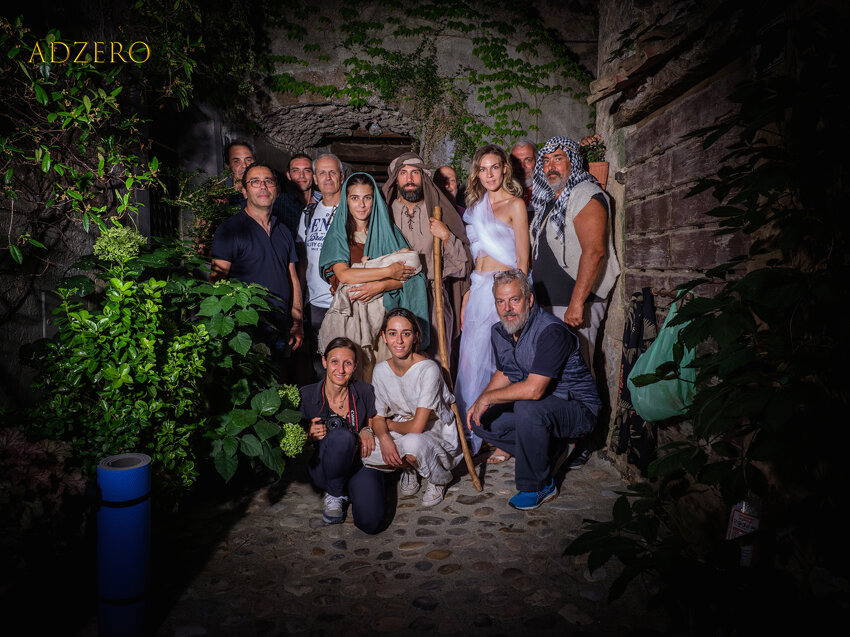
Reconstructing, adapting, interpreting… from Emperor Claudius to Jesus of Nazareth.
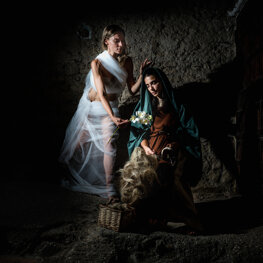
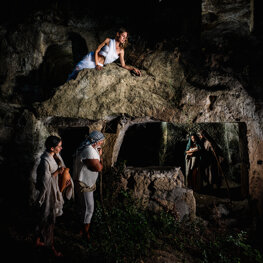
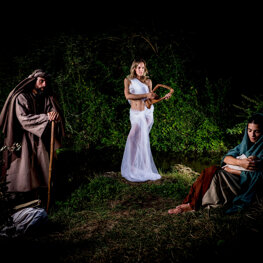
Historical reconstructions are a fascinating world. They allow you to capture in a single frame a moment that happened centuries… millennia ago. They let you recreate a historical or religious moment or revisit a work of art. I love this photographic genre.
A photographic genre in which the shot is certainly only one aspect among the thousands that need to be anticipated and planned.
It is a team effort and definitely requires harmony. Harmony not only from a strictly professional point of view but also in terms of imagination, creativity, and a good appetite.
Yes, a good appetite.
I have always been a firm believer in the uselessness of a thousand meetings, business encounters, brainstorming sessions, and that sort of thing. Especially when it comes to art and creativity.
The most beautiful things are imagined and invented at the table. There is nothing more creative than good company around a well-laid table and a good glass of wine or cold beer (in moderation, of course).
And it was precisely during a dinner, at the end of 2012, that with my friends Vincenzo Ricciarello and Massimo De Clementi, long-time historical reenactors, we came up with the idea for a photographic project for the following year’s Natale di Roma.
DCCC ab Urbe Condita, that is, 8 centuries since the founding of Rome, when Emperor Claudius introduced for the first time the celebrations for this event.
©Max Angeloni - All rights reserved
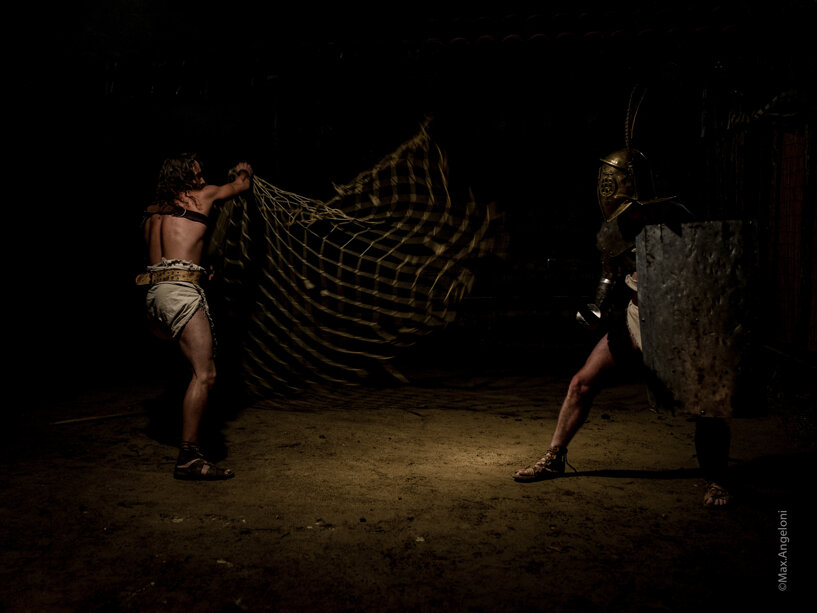
After 3 months of preparation (shooting dates, planning dozens of models, roles, costumes, scripts, makeup) the project took shape and became the photographic work for the launch of the Fujifilm X-M1 in Italy.
Of course, we celebrated with a nice dinner. And what happens at dinner if, in good company, you find yourself around a table set with a good glass of wine or an ice-cold beer (always in moderation, of course)?
The answer is obvious... you immediately start thinking about the next project.
From the Roman Natale to the Christian Easter is a short step.
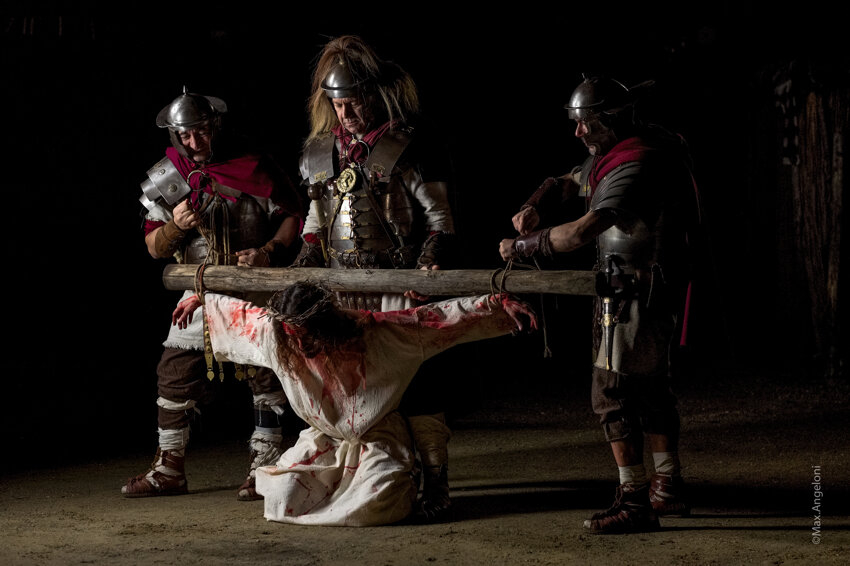
The preparation process was basically similar. But, while there were plenty of armors, uniforms, and legionary accessories, preparing the garments for Jesus, those of the Apostles and the Holy Women, as well as the uniforms of the temple officials, took a lot of time. The same goes for all aspects related to the cross and the crucifixion. Historical accuracy is the common thread in all our work, and once again we tried to be as plausible as possible with respect to what has been told to us for almost 20 centuries.
In the end, Via Crucis - The Way of Suffering saw... light.
Since 2014, dinners have become less frequent, thanks to common problems with cholesterol, blood pressure, triglycerides, and so on. So carrying out such ambitious projects has become a bit more complicated. After all, it is well known that without “tough and demanding business meetings” it is difficult to carry forward any idea.
But that's how it is.
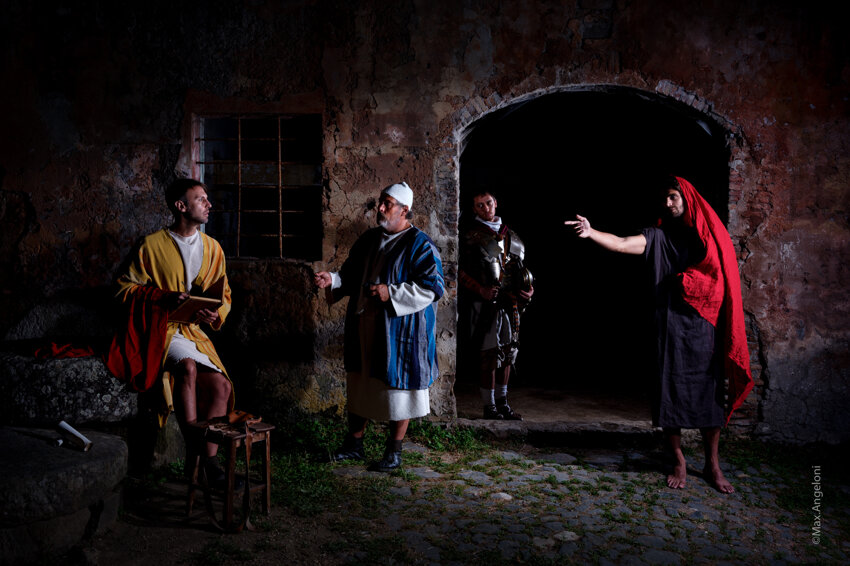
It took a few years of pseudo-dieting and, above all, a proposal that could not be refused from the painter Ippazio Campa to bring us back together around the table. No less than a reinterpretation of Caravaggio’s “The Calling of Matthew.” A project sponsored by the Pontifical Council for Culture.
From the final shot, the painting to be exhibited in the Cathedral of St. Matthew in Salerno would then be created.
So we pretended we had solved the problems of cholesterol, blood pressure, triglycerides, and so on, and, with paper (a greasy paper napkin, to be precise) and pen, we got back to work.
This time we needed something that would allow us to take another leap in quality.
In addition to confirming the wonderful Make up Artist Mara Genoese for the makeup and Maestro Andrea Camilletti for the original music, we needed two professional actors for the main roles.
Fortunately, friends are always there, and so Mauro Ermito became Jesus and Umberto Salamone St. Matthew. Last but not least, our friend Valter Ventrone also joined the group to give a further essential hand in creating this project.
Obviously, this work required the use of many more resources, and, as always, Fujifilm Italia did not hold back, just as they never had in the past. Thanks again
And so Mt. 9,9-13 was born.
From that experience, many things have stayed with us. And of all those things, one above all made us aware of an inescapable fact... we would never solve the problems of cholesterol, blood pressure, triglycerides, and so on. So why not take advantage of it to plan another project?
ADZERO... the origins.
“What do we want to do?... can you pass me the bruschetta?” “I was still thinking about combining sacred art and historical reenactment” “…mmh yes but… cough cough… oh god I was choking… can you pass me the water” “the arrosticini are good… what were we talking about?” “I was thinking something about Christmas” “Are you going skiing?” “No, I don't know how to ski... I was talking about photography... about Gabriele... pass me the cheese” “Gabriele... where is he... is he here? I haven't seen him in ages” “…but no, the Archangel Gabriel... oh well, I'm tired... the bill!” “yeah, exactly... working too much is bad.”